

From the Algorithm to the Patient: How Biomedical Acoustics is Transforming Preventive Medicine.
By Ehab Soltan
HoyLunes – For centuries, medicine has confined the human voice to the realm of expression and communication; an instrument shaped by culture, language, and emotion. In conventional clinical practice, its role has been, at best, secondary: a sporadic symptom or a minor diagnostic clue.
However, we are facing a profound transformation in the conception of diagnosis.
From the forefront of biomedical acoustics laboratories, artificial intelligence, and precision medicine, a hypothesis emerges that challenges traditional limits: the human voice is not just a means of communication, but a comprehensive and dynamic physiological biomarker, capable of reflecting the systemic health status of the organism in real time.
This is not a clinical metaphor. It is measurable physiological data.
In experimental settings, this approach is already beginning to materialize. Pilot studies have shown that patients with Parkinson’s disease present detectable vocal alterations years before the onset of motor symptoms. Similarly, acoustic analyses in mental health have identified consistent patterns in vocal modulation associated with major depression and chronic stress. These are not yet tools for generalized use, but they are an unequivocal signal: the voice is beginning to behave as an early clinical indicator, not as a belated consequence.
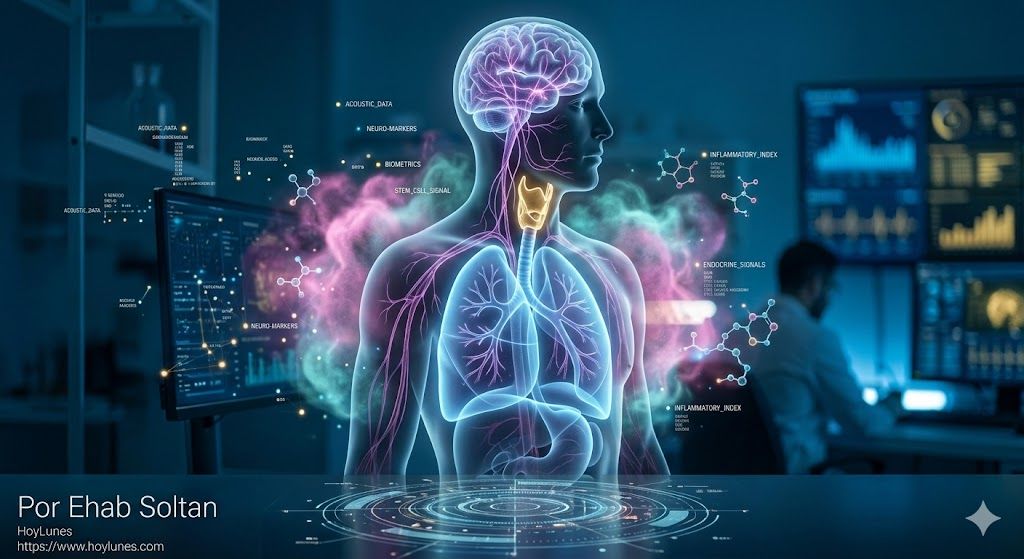
An Integrated Physiological System: The “Invisible Organ”
The production of voice is a phenomenon of astonishing complexity that transcends the mere vibration of the vocal cords. It is the acoustic manifestation of the harmonic interaction between multiple vital systems:
Respiratory System: The energy source (airflow).
Neuromuscular System: Precise control and laryngeal coordination.
Endocrine System: The subtle but potent hormonal influence on tissues.
Central Nervous System: Cognitive processing and emotional load.
Inflammatory State: The organism’s systemic response.
The implication is direct: any alteration, however subtle, in any of these systems leaves a detectable acoustic fingerprint. Often, these variations are imperceptible to the most trained human ear, but they are perfectly quantifiable through advanced algorithms.
Some machine learning models have achieved clinically relevant levels of precision in controlled contexts, especially in the detection of neurological and affective disorders. Although results vary depending on the methodology and sample size, the trend is consistent: the acoustic signal contains exploitable diagnostic information.
The Central Hypothesis: Voice as a Three-Dimensional Biological Interface
This line of research posits that voice operates as a three-dimensional biological interface that decodes and projects critical information:
Internal Physiological State (Physical Health)
Processes such as systemic inflammation, chronic fatigue, or specific respiratory pathologies directly impact the stability of tone, the vibratory quality of the vocal folds, and phonatory resistance. Pathognomonic vocal patterns associated with neurodegenerative diseases, mood disorders, and various lung pathologies have already been identified.
Psychological and Cognitive Load
Chronic stress, anxiety, and cognitive impairment modify laryngeal muscle tension, fundamental frequency variability, and speech fluency. Voice does not only communicate emotions; it encodes them physiologically.
Response to the Environment (Exposome)
Environmental factors such as temperature, humidity, and air pollution affect homeostasis and respiratory biomechanics, modulating voice as a biological system sensitive to its environment.
Biological Architecture and Sex Differences: Beyond High and Low Pitch
Historically, the vocal difference between men and women has been simplified to fundamental frequency (pitch). The current hypothesis delves into structural and functional divergences.
The female vocal system exhibits greater sensitivity to hormonal fluctuations (estrogens and progesterone), which induce cyclical changes in the laryngeal mucosa.
Furthermore, there is a higher prevalence of autoimmune and inflammatory disorders in women. This suggests that the female voice could function as a sharper sensor of internal physiological changes, but it also presents greater vulnerability to systemic dysregulations.
In contrast, the male vocal architecture tends to show greater structural stability and lower hormonal variability, responding differently to vocal stress. It is not a question of phonatory capacity, but of a differentiated biological architecture.
Vocal Chronology: Aging That Antedates Sight
Vocal aging, or presbyphonia, is a known phenomenon characterized by laryngeal muscle atrophy, loss of tissue elasticity, and neuromotor alterations.
However, the emerging hypothesis provides a revolutionary nuance: voice could function as an early signal of systemic aging and biological fragility, manifesting before other clinical signs become visible. Recent studies explore robust correlations between specific acoustic characteristics and early cognitive impairment or metabolic risk. Voice as a sentinel, not as a sequel.
The Technological Catalyst: AI and Inaudible Listening
The decisive advance toward the validation of this hypothesis comes not only from medicine but from its convergence with artificial intelligence.
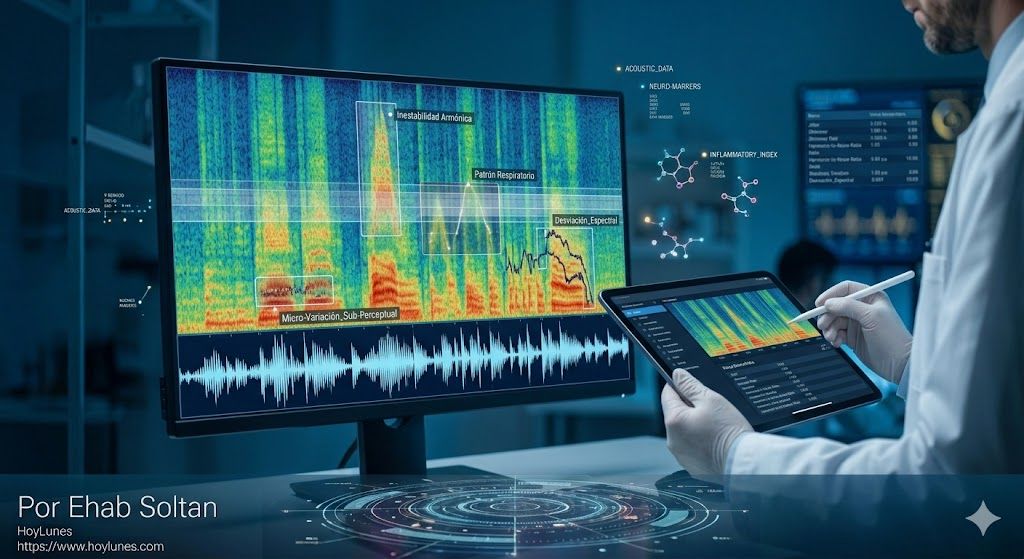
Machine learning and deep learning models are being trained to detect micro-variations in frequency, harmonic instabilities, and respiratory patterns hidden from the human ear.
Voice thus metamorphoses into a non-invasive, accessible, scalable, and continuous biomedical sensor, opening doors to:
Ultra-early detection of neurological diseases.
Objective monitoring of mental health.
Remote and passive monitoring of chronic patients.
Challenges and Horizons: What We Have Not Yet Resolved
Despite its undeniable potential, the consolidation of voice as a clinical biomarker faces significant obstacles:
Lack of Standardization: There is an urgent need to establish uniform protocols for vocal data acquisition and analysis.
Cultural and Linguistic Biases: It is imperative to discern between biological variations and cultural speech patterns.
Interpretive Integrity: The risk is not the technology, but algorithmic overinterpretation without clinical context.
Ethics and Privacy: The protection of biometric privacy in an interconnected world is fundamental.
Added to this is an additional challenge: intra-individual variability. A person’s voice changes throughout the day based on fatigue, hydration, or emotional context. Without models that integrate this variability, the risk of false positives remains significant.

A New Question for Preventive Medicine
If this hypothesis is confirmed—and accumulated scientific evidence suggests it will—the implication for medical practice is profound and disruptive: voice will cease to be merely a communication tool and become a primary diagnostic tool.
This forces us to rethink a fundamental premise:
What if the human body has been screaming its health status for years… and medicine simply lacked the technology or the disposition to listen correctly?
In practical terms, this opens the door to a scenario where a simple vocal interaction—a call, a remote consultation, or even the daily use of smart devices—could be integrated into passive monitoring systems. Medicine would move from reacting to symptoms to detecting subtle deviations in real time.
From Language to Clinical Data
Voice is one of the most intrinsically human manifestations. Paradoxically, it has been one of the most underestimated from a medical perspective. In a clinical landscape that demands non-invasive, predictive, and continuous systems, it emerges as an exceptional candidate. It will not replace traditional diagnostic tests, but it could drastically anticipate them. And within that anticipation lies the power to redefine the relationship between diagnosis, technology, and the human experience of health.
If 20th-century medicine was built on imagery and laboratory analysis, 21st-century medicine could rely on continuous, invisible, and non-invasive signals. Among them, voice stands out not for its novelty, but for having always been present, waiting to be understood.
Documentary and Authoritative Sources (Suggested to reinforce the piece):
National Institutes of Health (NIH):Pioneering research on vocal biomarkers in neurological and mental health.
Nature Reviews Neurology: Critical studies on the relationship between speech acoustics and neurodegenerative diseases.
The Lancet Digital Health: Publications on the application of AI in voice analysis for medical diagnoses.
World Health Organization (WHO): Guidelines on mental health, active aging, and digital monitoring.
Journal of Voice: Fundamental research in vocal physiology, acoustics, and biological differences by sex and age.
Note: This information is purely for informational and educational purposes based on current lines of research. For medical advice, diagnosis, or treatment, always consult a qualified healthcare professional.
#VocalBiomarkers #AIinHealth #PrecisionMedicine #MentalHealth #MedicalInnovation #BiomedicalAcoustics #PreventiveMedicine #HoyLunes #EhabSoltan